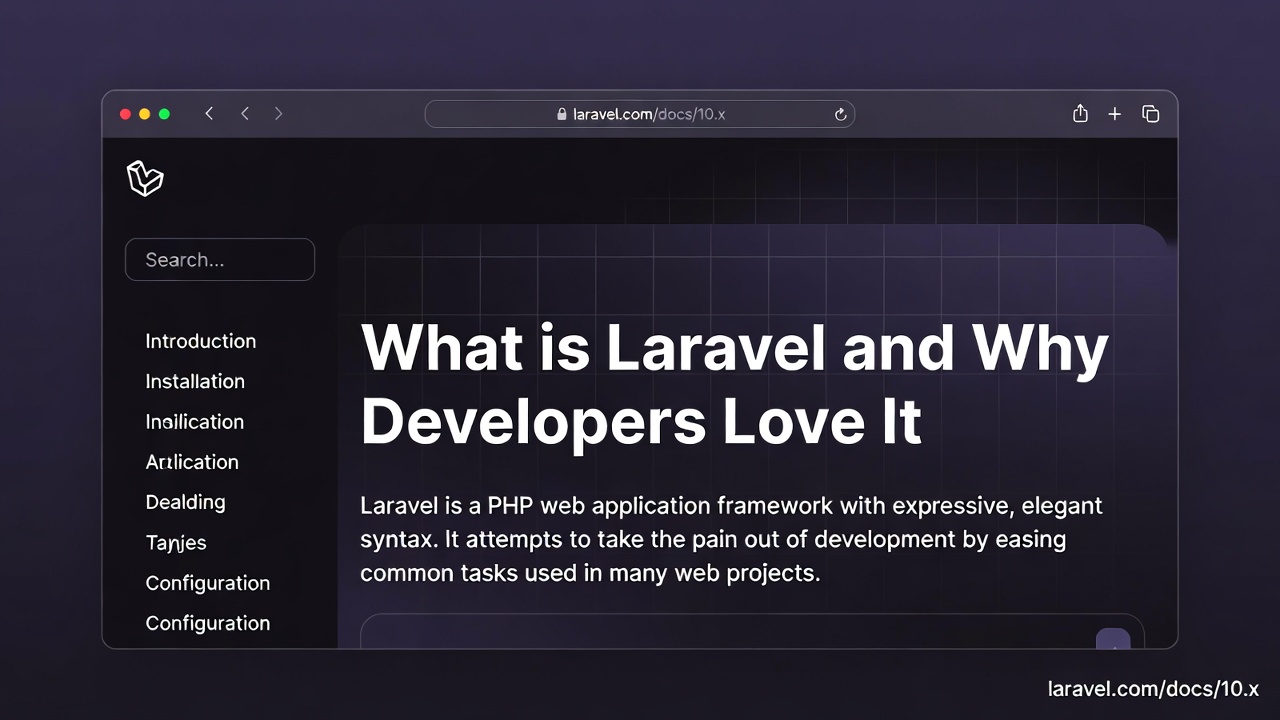
What is Laravel and Why Developers Love It

Web development has evolved significantly over the years. In the early days, developers often built websites using plain PHP scripts combined with HTML and CSS. While this approach worked for simple projects, it quickly became difficult to manage as applications grew larger and more complex.
To solve this problem, developers began using frameworks that provide structure, reusable tools, and best practices for building web applications. One of the most popular frameworks in the PHP ecosystem today is Laravel.
Laravel is a modern PHP framework designed to make web development easier, faster, and more enjoyable. It provides a clean and elegant syntax along with powerful features that help developers build scalable applications with less effort.
Since its release, Laravel has gained massive popularity among developers worldwide. From small personal websites to large enterprise platforms, Laravel is widely used to build secure and maintainable applications.
In this article, we will explore what Laravel is, its key features, and why so many developers choose it for their projects.
Laravel is an open-source PHP framework used for building modern web applications. It was created by Taylor Otwell in 2011 with the goal of simplifying common development tasks and improving the developer experience.
Laravel follows the Model-View-Controller (MVC) architectural pattern. This pattern separates an application into three main components:
Model – Handles the data and business logic
View – Manages the user interface
Controller – Processes requests and coordinates between models and views
By separating these responsibilities, Laravel helps developers keep their code organized and maintainable.
Another important aspect of Laravel is its expressive and readable syntax. Many developers appreciate how Laravel allows them to write clean and understandable code while still providing powerful functionality.
Because of these advantages, Laravel has become one of the most widely used PHP frameworks in modern web development.
Laravel offers a wide range of features that make web development more efficient. These built-in tools help developers focus on building application logic rather than reinventing common functionality.
Some of the most important Laravel features include routing, database management, authentication, and templating.
These features allow developers to build complex applications faster while maintaining a clean and structured codebase.
Routing is one of the fundamental features of Laravel. It allows developers to define how an application responds to different URLs.
Instead of writing complex scripts to handle requests, developers can simply define routes that map URLs to specific controllers or functions.
Laravel’s routing system is easy to read and very flexible.
Route::get('/welcome', function () {
    return 'Welcome to Laravel!';
});Laravel includes a powerful templating engine called Blade. Blade allows developers to create reusable templates and easily integrate dynamic content into their views.
Unlike plain PHP templates, Blade provides clean syntax for loops, conditions, and template inheritance.
This helps keep frontend code organized and easier to maintain.
Blade templates also allow developers to reuse common components such as headers, footers, and navigation bars.
<h1>Hello, {{ $name }}</h1>Laravel includes a powerful Object-Relational Mapping (ORM) system called Eloquent. Eloquent allows developers to interact with databases using simple and expressive PHP syntax instead of writing raw SQL queries.
With Eloquent, database tables are represented as models. Developers can then perform operations such as creating, updating, retrieving, or deleting records using these models.
This approach makes database interactions more intuitive and easier to maintain.
$users = User::all();

foreach ($users as $user) {
    echo $user->name;
}Authentication is a common feature in most web applications. Laravel simplifies this process by providing built-in authentication tools.
Developers can quickly implement features such as user registration, login, password resets, and email verification without writing complex authentication logic from scratch.
This saves a significant amount of development time and ensures security best practices are followed.
Laravel provides a migration system that allows developers to manage database schema changes using version-controlled files.
Instead of manually modifying database tables, developers can define changes using migration scripts. These scripts can then be applied consistently across different environments.
This approach ensures that the database structure remains synchronized across development, testing, and production environments.
Schema::create('posts', function (Blueprint $table) {
    $table->id();
    $table->string('title');
    $table->text('content');
    $table->timestamps();
});Laravel has gained a loyal following among developers for several reasons. One of the main reasons is its focus on developer productivity.
Laravel provides many built-in features that reduce the amount of repetitive code developers need to write. This allows developers to focus on building application features rather than solving low-level problems.
Another reason developers love Laravel is its elegant syntax. The framework encourages clean code and follows modern development standards.
Laravel also has an incredibly active community. Thousands of developers contribute tutorials, packages, and open-source tools that extend Laravel’s capabilities.
This strong ecosystem makes it easier for developers to find solutions, learn new techniques, and build better applications.
Laravel is more than just a framework. It is part of a larger ecosystem of tools designed to simplify web development.
Some popular tools in the Laravel ecosystem include:
Laravel Breeze – simple authentication scaffolding
Laravel Sanctum – API authentication
Laravel Horizon – queue monitoring
Laravel Nova – admin panel management
These tools help developers build complete applications with less effort and better organization.
Because of this rich ecosystem, Laravel continues to grow in popularity among both beginners and experienced developers.
Laravel is a great choice for many types of web applications. It is particularly well-suited for projects that require robust backend logic, database interactions, and user authentication.
Some common use cases include:
Content management systems
E-commerce platforms
SaaS applications
APIs for mobile applications
Business dashboards
Laravel’s flexibility makes it suitable for both small personal projects and large enterprise-level systems.
Laravel has become one of the most influential PHP frameworks in modern web development. By providing powerful tools, clean syntax, and a strong ecosystem, Laravel makes it easier for developers to build scalable and maintainable applications.
In this guide, we explored what Laravel is, its key features, and why developers around the world enjoy using it.
Whether you are building your first web project or developing a complex platform, Laravel offers a solid foundation that can help you build applications faster and more efficiently.
For developers who want to work with PHP in a modern and structured way, Laravel is undoubtedly one of the best frameworks to learn and use.
 Mar 07, 2026
Learn how to create your first Laravel controller in this beginner-friendly guid...
 Mar 07, 2026
Learn how Laravel routing works in this beginner-friendly guide. Understand how...
 Mar 07, 2026
Understanding the Laravel project structure is essential for every Laravel devel...


Leave a Comment